

01 Oct How to Choose a Drywall Contractor in Denver
Searching “drywall contractors near me” turns up a long list of names, but proximity doesn’t tell you who’s actually qualified to work in your home or building. In Denver, drywall quality varies more than most homeowners expect — the difference between a crew that rushes through a Level 3 finish and one that properly tapes, coats, and sands to Level 5 is often invisible until you turn on a light at the wrong angle. Choosing the right contractor comes down to verifying credentials, understanding what type of work you actually need done, and asking questions that expose how a company really operates.
What should I check before hiring a drywall contractor in Denver?
Start with licensing and insurance, then move to scope and fit. Denver has a mix of large commercial outfits, small residential crews, and handymen who do drywall as a side service. All three can call themselves “drywall contractors,” but only some carry the credentials and coverage that protect you if something goes wrong on the job.
Is a drywall contractor required to be licensed in Denver?
General contracting work in the City and County of Denver, including drywall installation tied to remodels, additions, or new construction, typically falls under local licensing requirements. A licensed drywall contractor has gone through the city’s vetting process and is accountable to a permitting and inspection system — which matters more than people realize on jobs involving fire-rated assemblies, sound-rated walls in multi-family buildings, or any work that touches electrical and plumbing penetrations. Ask for a license number up front. A legitimate company will give it to you without hesitation, and you can verify it through Denver’s licensing portal.
Why does insurance matter more than people think?
Drywall work involves ladders, scaffolding, power tools, and dust that can travel into HVAC systems. General liability insurance covers property damage — a dropped panel that cracks your hardwood floor, overspray from texture that gets on cabinets, or a tape joint that fails and causes water damage down the line. Workers’ compensation coverage protects you if a worker is injured on your property. Ask for a certificate of insurance before signing anything, not after. A contractor who’s slow to produce one is telling you something.
Need Commercial Drywall Work Done Right?
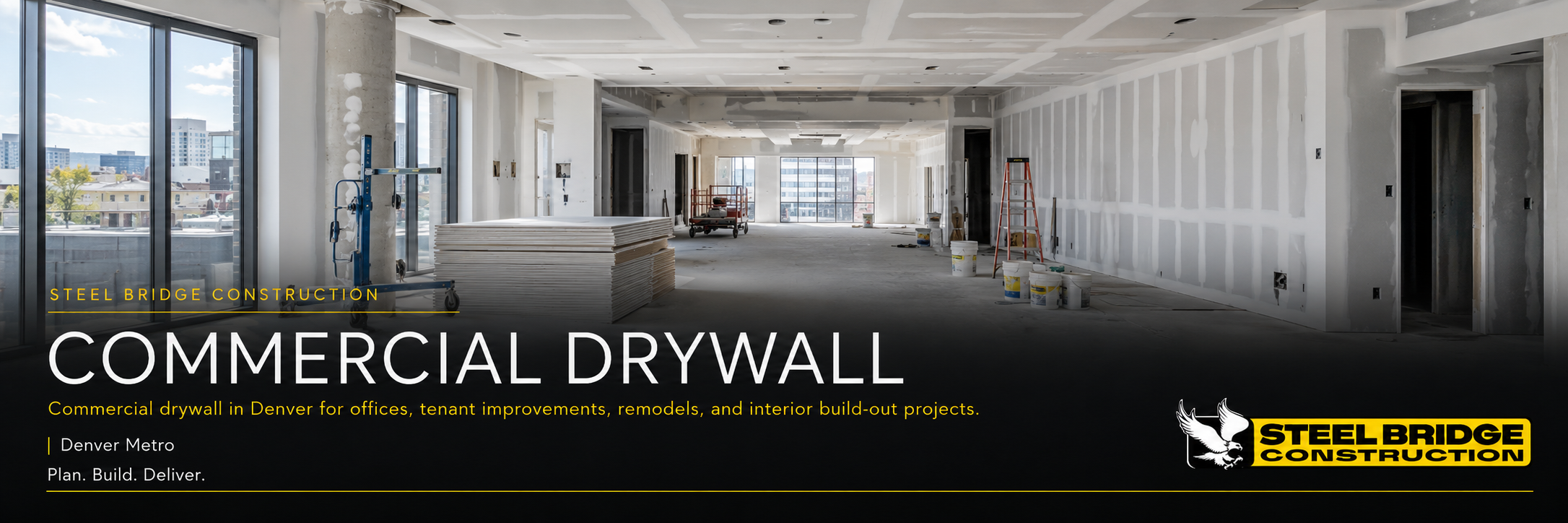
Steel Bridge Construction handles drywall installation, taping, and finishing for homes and businesses across the Denver metro.
Get a Free EstimateWhat’s the difference between commercial and residential drywall contractors?
Not every contractor who hangs drywall in houses is set up to handle a tenant finish-out, and not every commercial crew wants a small bathroom patch job. Knowing which category your project falls into helps you narrow the search fast.
How does commercial drywall work differ from residential?
Commercial drywall jobs — office build-outs, retail spaces, restaurants, multi-family corridors — usually involve metal stud framing instead of wood, fire-rated and sound-rated assemblies governed by specific UL designs, and tight timelines coordinated around other trades like electrical, mechanical, and fire sprinkler contractors. These jobs often require after-hours or weekend work to avoid disrupting an operating business, and they almost always involve permits and inspections tied to a certificate of occupancy. A commercial drywall contractor in Denver needs crews who can read architectural drawings, hit fire-rating specs exactly, and keep a job site clean enough for other trades to work around.
Residential drywall — new construction, basement finishes, additions, repairs — is generally wood-framed, has fewer code triggers, and is scheduled around a homeowner’s life rather than a lease deadline. The finish expectations can actually be higher on the residential side, since homeowners are living with the walls up close every day, while commercial tenants are often more focused on function and timeline.
Can one contractor handle both types of work?
Some can, but it’s worth asking directly rather than assuming. A contractor who primarily does residential patch-and-paint work may not have experience with fire-rated assemblies or commercial permitting, and a commercial-focused crew may not have the finesse for a seamless Level 5 finish in a living room. When you’re evaluating a company, ask to see examples of both — recent commercial build-outs and recent residential finish work — before deciding they’re the right fit for your specific project.
What questions should I ask a drywall contractor before hiring them?
A short conversation reveals a lot. The right questions get past the sales pitch and into how the company actually runs jobs.
What should I ask about scope, materials, and timeline?
- What finish level are you quoting — Level 3, 4, or 5 — and does that match what the space needs?
- Will you pull a permit, and who’s responsible for scheduling inspections?
- What type of board are you using in bathrooms, garages, or areas near moisture — moisture-resistant, cement board, or standard?
- How many coats of joint compound are included, and how many days does drying and sanding add to the schedule?
- Who’s doing the actual hanging and taping — in-house crew or subcontracted labor?
- Is dust containment included, especially for occupied homes or active commercial spaces?
If you want a deeper breakdown of how pricing is typically structured and what drives cost up or down, our guide on drywall installation cost and process walks through square footage pricing, material upgrades, and labor factors in more detail.
How do I compare quotes that look completely different?
Two bids for the “same” job can vary by thousands of dollars, and the gap usually comes down to scope assumptions. One contractor might be quoting Level 4 finish with standard board; another might be including Level 5 skim coat, moisture-resistant board in wet areas, and full debris removal. Before comparing numbers, make sure every quote specifies the same finish level, the same board type, and the same cleanup terms. If a quote doesn’t list these details, ask for them in writing before you sign.
What’s a reasonable timeline and cost range for drywall work in Denver?
Timelines and pricing shift based on project size, finish level, and whether the work is new installation or repair. Having a general range in mind helps you spot a quote that’s unrealistically low or padded too high.
How long does a typical drywall project take?
A single room usually runs 3 to 5 days once you account for hanging, taping, multiple coats of mud, drying time between coats, sanding, and a final inspection pass. A full basement finish or small commercial tenant space often takes 1 to 3 weeks depending on square footage and how many other trades are coordinating around the drywall crew. Larger commercial build-outs can run longer, particularly when fire-rated assemblies require inspection sign-off before the next phase can start.
What’s a realistic cost range by project type?
| Project Type | Typical Timeline | Cost Range (approx.) |
|---|---|---|
| Small repair or patch (1-2 spots) | 1 day | $150 – $500 |
| Single room, new drywall | 3 – 5 days | $1,200 – $3,500 |
| Basement finish (500-1,000 sq ft) | 1 – 3 weeks | $4,000 – $12,000 |
| Whole-house new construction | 3 – 6 weeks | $15,000 – $40,000+ |
| Commercial tenant finish-out | 2 – 8 weeks | Varies by square footage and fire-rating requirements |
These are general planning ranges, not a quote — actual numbers depend on ceiling height, access, finish level, and local permitting. For a more specific estimate tied to your square footage, the drywall estimating guide is a useful starting point before you request bids.
Does a Denver drywall contractor need to know the local service area?
Permitting, inspection scheduling, and even material lead times can vary by jurisdiction within the Denver metro. A contractor who works across the area regularly knows which inspectors to expect on a commercial fire-rated job, how long permit turnaround typically takes in a given municipality, and how weather affects scheduling for projects that involve exterior access or garage conversions.
Why does local experience change the outcome of a project?
A contractor unfamiliar with Denver’s permitting process can lose days or weeks waiting on paperwork they didn’t anticipate. One who’s handled dozens of jobs across the metro — from downtown commercial spaces to suburban basement finishes — already knows the sequence, the common inspection sticking points, and realistic lead times for materials. That translates directly into fewer surprises on your schedule and budget.
If you’re unsure whether a contractor actively works in your part of the metro, check their listed service area before requesting a quote — it’s a fast way to confirm they’re not stretching outside their usual territory for your job.
Ready to get a straight answer on your drywall project?
What’s the fastest way to get a reliable quote?
The most efficient path is a direct conversation with a licensed, insured contractor who can walk your space, confirm finish level expectations, and give you a written scope — not a ballpark guess over the phone. Steel Bridge Construction handles both commercial and residential drywall throughout the Denver metro, from single-room repairs to full tenant build-outs. Call (720) 930-5728 or request a quote online to get a crew out to your site and a real number in hand.
Ready to Start Your Drywall Project?
From a single patch to a full commercial buildout, our crews handle the framing, hanging, and finish work so the walls look right the first time.
Get a Free EstimateFrequently Asked Questions
How do I verify a drywall contractor’s license in Denver?
You can ask the contractor directly for their license number and then confirm it through the City and County of Denver’s licensing lookup tool. Any legitimate licensed drywall contractor will provide this without pushback.
Is it worth hiring a licensed contractor for a small drywall repair?
For a single patch, licensing matters less since most small repairs don’t require a permit. But if the repair involves a fire-rated wall, a load-bearing area, or is part of a larger remodel, working with a licensed contractor protects you if the work needs to pass inspection later.
What’s the difference between a drywall finisher and a general contractor who does drywall?
A drywall finisher typically specializes only in taping, mudding, and texture, often as a subcontractor. A general contractor who offers drywall services can usually handle the full scope — framing, hanging, finishing, and coordinating any related electrical or insulation work — under one point of contact.
How many quotes should I get before hiring a drywall contractor?
Two to three is usually enough to understand the going rate and spot outliers. Make sure each quote specifies the same finish level and materials so you’re comparing equivalent scopes, not just bottom-line numbers.
Do commercial drywall jobs require different permits than residential ones?
Often yes. Commercial spaces frequently involve fire-rated and sound-rated assembly requirements tied to occupancy type, which means more detailed plan review and inspection steps than a typical residential remodel.
Can the same contractor handle both drywall installation and the painting afterward?
Many drywall contractors either handle paint in-house or coordinate directly with a painting crew, which keeps the finish level consistent between taping and topcoat. It’s worth asking upfront whether that’s included or needs to be arranged separately.
More Drywall Guides
- What Is a Level 5 Drywall Finish? (And Do You Actually Need It)
- Drywall Thickness Guide: 1/2″ vs 5/8″ vs Fire-Rated
- Sheetrock vs. Drywall: What’s the Difference? (There Isn’t One)
- How Much Drywall Do You Need? A Simple Estimating Guide
- Ceiling Drywall Installation: Why It’s Harder Than Walls
- Drywall Finish Levels Explained (Level 0 Through Level 5)
- Drywall Taping & Finishing: What Separates a Good Job from a Bad One
- How Drywall Installation Actually Works: The Full Process
- Professional Drywall Installation in Denver: Cost, Process & What to Expect
- Drywall Repair and Painting: Getting a Seamless, Invisible Patch
- Drywall Patch Kits: When They Work (and When to Call a Pro)
- Water-Damaged Drywall: Warning Signs & Repair Options
- Ceiling Drywall Repair: Holes, Water Stains & Sagging
- Why Is My Drywall Cracking? Causes & When to Call a Pro
- How Much Does Drywall Repair Cost in Denver, CO?
- Drywall Repair 101: How to Fix Holes, Cracks & Water Damage
No Comments